


Chemical and Pharmaceutical Industry
Interview

Fermentation tank
Biological processes are some of the most complicated processes confronting engineers today. Many parameters influence the outcome of the reaction, and the interrelations of these parameters are not always known. Some of these parameters must be within very critical ranges. After successful testing on small scale, the scale-up can come out just as predicted. Typically, though, the scale-up always brings some new surprises, often resulting in unwanted lower yields, inseparable byproducts, and DO-crashes (DO= dissolved oxygen).
There are many parameters that influence a fermentation that are solely related to the effect of mixing. Many of these parameters affect biological processes much more than chemical processes. Obvious parameters are position of the impeller or impellers, type of impeller, size of impeller and impeller speed. Not so obvious are parameters that are influenced by mixing, such as heat transfer, pumping capacity and mixing times, flow patterns, shear, and energy dissipation. Other non-mixing parameters, though, can directly affect the performance of the mixer, too, such as viscosity, baffling, presence of cooling coils, placement of the nutrient additions, sparge configuration and gas rate.
Many fermentations must operate within very tight temperature, pH, and dissolved oxygen constraints. The cooler fluid at the wall of the heat transfer surface (jacket or coils) must be quickly distributed throughout the tank contents to achieve a uniform temperature profile and minimize hot spots. The addition of nutrients and acids or bases to keep pH sensitive broths constant is typically added to the fluid surface. Without adequate blending, these additions can cause zones of high concentrations near the oxygen depleted upper section of the fermenter and low concentrations near the lower oxygen rich zone. Axial flow type impellers are well known for producing high amounts of fluid flow for a given power input. Many of them are also typically poor dispersers of gas.
Rushton impellers are also known to be poor producers of fluid flow for a given power input. Many fermentations must operate within very tight temperature, pH, and dissolved oxygen constraints. The cooler fluid at the wall of the heat transfer surface (jacket or coils) must be quickly distributed throughout the tank contents to achieve a uniform temperature profile and minimize hot spots. The addition of nutrients and acids or bases to keep pH sensitive broths constant is typically added to the fluid surface. Without adequate blending, these additions can cause zones of high concentrations near the oxygen depleted upper section of the fermenter and low concentrations near the lower oxygen rich zone. Axial flow type impellers are well known for producing high amounts of fluid flow for a given power input. Many of them are also typically poor dispersers of gas.
Fermentations are, as mentioned earlier, very complicated. Early industrial experiences with upper axial impellers and a lower RT showed in some cases excellent results and in other cases poorer results. Since all small-scale mixers produce enough flow, the best comparisons came from the industry. Typically, the large-scale fermenters are not fitted with state-of-the-art equipment and so the effect of the mixers is solely judged on yield, the time to achieve that yield and/or, DO-profile. The underlining mechanism for that improvement is not always so clear. Apparently, some of the poorer results were due to poorly designed (in respect to gas handling) axial impellers that were flooded upon scale-up. The design of the LUNRON’s H|YF318 impeller mitigated these problems, and the added effect of high blending rates usually improved the process by decreasing the mixing time.
The lower RT upper dual HYF318 configuration proved to be the best configuration when based on mass transfer alone. This is an indication that one type of impeller alone cannot achieve the optimum blend of flow and shear. Since most fermentations add the gas only at the bottom, the majority of the gas is consumed in the lower third oxygen rich zone of the tank. Here shear is more important than flow.
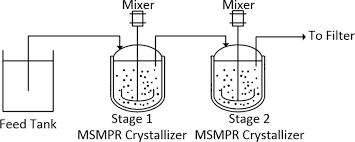
Cristalization Tank
The mixing characteristics are as follows:
1. Since the combined impeller has a diameter close to the tank diameter, it is suitable for crystallization of materials close to non-Newtonian fluids, and also prevents the occurrence of sticking wall, which is beneficial to the heat transfer efficiency of the tank wall.
2. The radial flow of the combined impeller and the axial flow along the four walls upward and the center of the tank and the organized flow of the whole tank liquid ensure the uniformity of the crystallization liquid in the whole tank.
3. Low-speed stirring will not cause huge shearing force and cause crystal damage.
4. The multi-layer impeller can adapt to the change of the liquid level of the crystal liquid.5, coupled with the use of variable speed stirring, can obtain the ideal nucleation and crystal growth conditions.
Mixing determines the environment in which crystals nucleate and grow and is therefore intrinsic to industrial crystallization. Individual nucleating and growing crystals respond directly to their microenvironment and not in a simple way to the macroenvironment, often thought of as the bulk or average environment. Because the growing crystal removes solute from solution and the dissolving crystal releases it, the solute concentration and therefore the supersaturation is in general different at the crystal surface than in the bulk. Crystals grow when the microenvironment is supersaturated, stop when it is just saturated, and dissolve when it is undersaturated. In most cases, impurities are rejected by growing crystals; therefore, each growing crystal face creates a zone of locally higher impurity concentration immediately adjacent to it. The growth rate and amount of impurity taken up by the growing crystal are functions of the impurity concentration where growth is occurring – at the crystal face itself. Mixing is the family of processes that links this local microenvironment to the macroscopic scale of the crystallizer by affecting the mass transfer between crystal and the larger environment and the dynamics of crystal suspension flow in the crystallizer. Mixing, therefore, to a large extent creates the crystal microenvironments. Furthermore, it determines the homogeneity of the macroenvironment, both temporally and spatially. Inhomogeneity in the macroenvironment affects the microenvironments around crystals, causing temporal variations as the crystals circulate from one zone to another inside the crystallizer.
Lunron Mixing Technology has initiated numerous mixing processes using her agitators. In some of these mixing processes, crystallization was a key factor in acquiring the desired final product. The process of crystallization is well-known in the chemical, pharmaceutical. In many cases, crystallization is a process that occurs as part of the process requirements for cooling a liquid, enabling crystal formation. Lunron Mixing Technology has supplied crystallization agitators for many projects. In order to prepare lactose for further processing in the pharmaceutical industry, Lunron Mixing Technology was approached by her customer which was in search of an application to separate lactose correctly by means of Crystallization.
The most important preconditions in the crystallization process that Lunron Mixing Technology had to take into account were the following:
- A large working area had to be created in order to optimizecrystal growth.
- The product was not allowed to settle on the bottom
- The crystals had to be the correct size, with the best quality.
- The heat dissipation had to match the crystallization processoptimally.


 Copy product links
 Long by picture save/share
INQUIRY


Add Successfully
INQUIRY
Add Successfully


Shanghai Sharpe Mechanical Equipment Co;,Ltd copy rights
Website: www.lunronmixer.com Email: sales@lunronmixers.com
Shanghai Sharpe Mechanical Equipment Co.,Ltd copyrights
 客服1
客服1 客服2
客服2