


Impeller
Interview
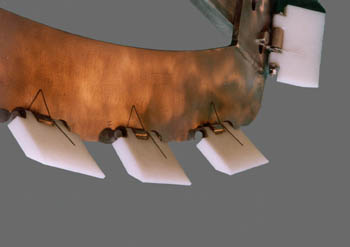
Lunron Anchor Impeller
An impeller designed for higher viscosity products. An anchor is normally "U" shaped, and follows the contour of the tank, with minimal clearance between the outside of the blade and the tank wall. Anchor impellers are specifically designed to fit the particular process. Two or four blades; with or without lower "tank bottom" blades; with either all-welded or bolted assemblies with adjustable blades. Axial-flow impeller blades may be incorporated into the horizontal supports to aid in the vertical movement of of the product. For removal of product from the tank wall for heat transfer or other needs, spring-loaded wipers (pictured above) are available in various compatible materials.

Lunron Axial Impeller
The pitched blade turbine is essentially a modified open flat blade turbine with the blades angled. Available with different number of blades, blade widths and different blade angles, the 4-blade, 45" pitch is the most popular. It is a good compromise between high pumping efficiency and high shear for processes that require both centipoises. The axial flow turbine is significantly more efficient than the radial flow turbine in terms of flow per horsepower. Flow is discharged both axially and radially depending on the angle. For example, the 45' axial flow turbine discharges one half of total flow axially and one half radially. The 45' axial flow turbine is more efficient at all Reynold's numbers than the flat blade radial turbine. However, as the pitch angle decreases below 45", the impeller becomes increasingly sensitive to high viscosity. These turbines are used for blending of miscible materials up to 50,000 centipoises, solids suspension and heat transfer. They can be used in any flow governing application.

Lunron Helix Impeller
An impeller designed for higher viscosity products. A helix is shaped like a spiral, usually rotating close to the tank wall. The Flights of the helical shaped blades move the product up (or down) the tank wall, promoting top-to-bottom motion in viscous materials that is superior to simple anchor or "picket-fence" impellers. Helix impellers are specifically designed to fit the particular process. One, two or more helix flights; with or without lower "tank-bottom" blades; with either all-welded or bolted assemblies with adjustable blades. An internal screw (auger) may be added to the shaft to aid in material turnover.

Lunron Hyflo Impeller
The high flow efficiency is a direct result of the blade characteristics. During development, particular attention was given to the camber of the blade and the blade angle. The camber approximates the shape of an airfoil to provide maximum flow efficiency. The camber is the amount of apparent arch to the blade when viewed from the end of the blade towards the hub. The proper amount of camber allows the blade to be operated at higher blade angles without incurring a stalled condition. In a similar way that an airplane wing will go into a stalled condition if the angle of attack is too great, the same can occur with fluid impellers. At excessive blade angles, the flow will tend to separate from the backside of the blade and eddies behind the leading edge of the blade. This is an indication that a stalling condition exists accompanied by increasing hydraulic shear. The HYFLO 218 impeller is optimized to operate in a non- stalled condition over the widest possible range of operating conditions.
The HYFLO 218 stands out from the competition in the way each impeller is fine tuned to each application. LUNRON MIXERS calculates the fluid velocity over the turbine blades to determine the shape and curvature that will be most efficient. The result is a custom designed and fabricated impeller providing optimum pumping capacity at minimum shear. The HYFLO 218 has proven to be successful in thousands of applications, from 4" to 174" diameters.
The more specialized HYFLO 312 has a lower blade angle and is often standard for side entering paper stock applications, but can be used when applicable for blending, solids suspension and heat transfer.
The wide blade Hyflo 518 is built for higher viscosity applications, or where maximum flow must be attained with a limited diameter impeller.
This family of impellers pumps considerably more per horsepower than other turbines because of their hydrofoil design. However, they are very sensitive to higher viscosities and their performance characteristics should be compared with axial flow turbines at viscosities over 3,000 centipoises.

Lunron Marine Style Propellers
One of the best shapes for a mixing impeller is that of the 3-blade marine propeller. This impeller is quite sophisticated. It incorporates a complex blade shape that can only be readily manufactured as a casting. There lies its downfall. Cast marine propellers are heavy. They create a mechanically limited design, because of the large shafts and gear reducers necessary to support their weight. Fabricated impellers were developed for just this reason. Today the only place we see the marine propeller used on mixing equipment is the smallest portable mixers, where propeller diameters are in the 3" - 6" range.
Marine type propellers are the same as those used on ships. Usually they are driven at speeds above 190 RPM. The flow is primarily axial (discharge flow parallel to the agitator shaft) and are most effective in low viscosity fluids.
The leading face can be flat or concave while the back side is convex. The pitch is on the basis of its being a section of a helix. Pitch is described as the advance per revolution. Almost all propellers today are square pitch where the pitch is equal to 1.0 times the diameter, or the impeller would advance a distance equal to it's diameter in one revolution. Propellers having a pitch ratio of 0.7 are becoming more popular, due to the higher efficiency of the low blade angle. Propellers are characterized by high discharge capacity with low head. Another characteristic (although seldom mentioned) is the sensitivity to almost any change in viscosity. The propeller is an efficient pumping device when comparing propeller flow to horsepower.
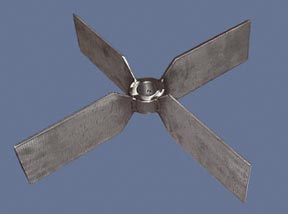
Lunron Radial Impeller
The Flat-Blade Radial Turbine has blades in the vertical plane, parallel to the mixer shaft having a minimum of two blades. Four blades are most commonly used although radials are available with as few as two blades to as many as eight. The flow is discharged radially and splits into two equal flows after leaving the blade tips. Suction is equal from top and bottom.
This type of turbine is almost insensitive to viscosity until laminar flow occurs. Two types of radial turbines are generally in use. They are the open type with blades fastened to the impeller hub, or the disc type with blades fastened to a disk which is fastened to the hub (Also known as a Rushton Turbine). Flat blade turbines are used when radial flow and high shear is desirable. This impeller is ideal for immiscible liquid emulsion applications. It is often used as a "clean-up" or "tickler" for agitating the very bottom of a tank or keeping a bottom tank discharge clean.


 Copy product links
 Long by picture save/share
INQUIRY


Add Successfully
INQUIRY
Add Successfully


Shanghai Sharpe Mechanical Equipment Co;,Ltd copy rights
Website: www.lunronmixer.com Email: sales@lunronmixers.com
Shanghai Sharpe Mechanical Equipment Co.,Ltd copyrights
 客服1
客服1 客服2
客服2